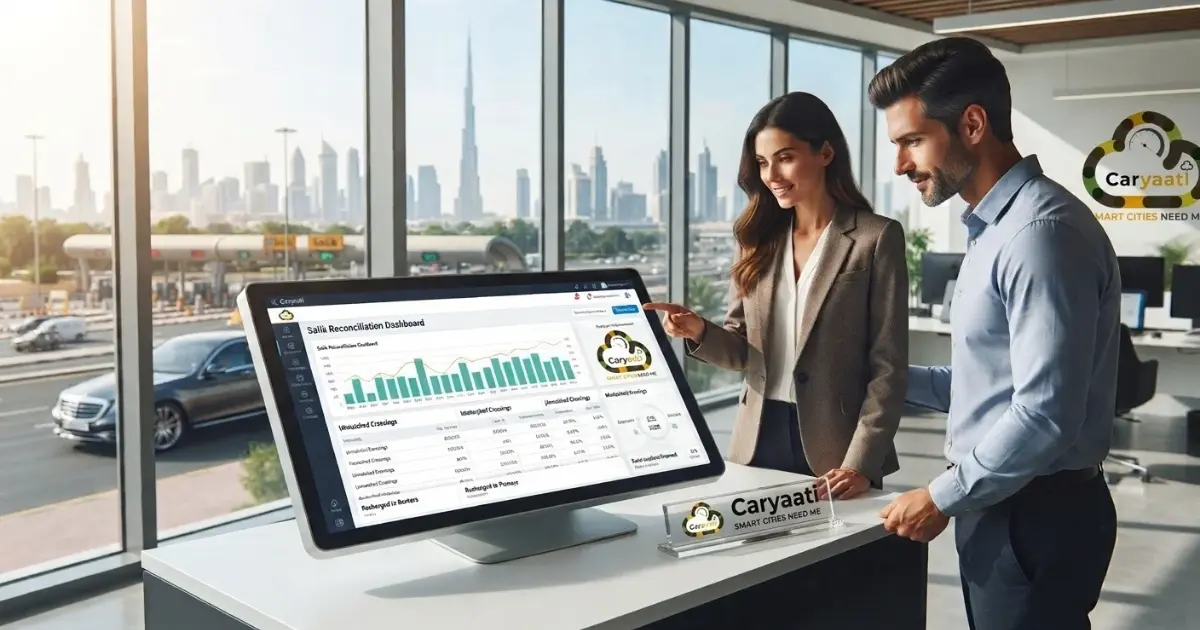
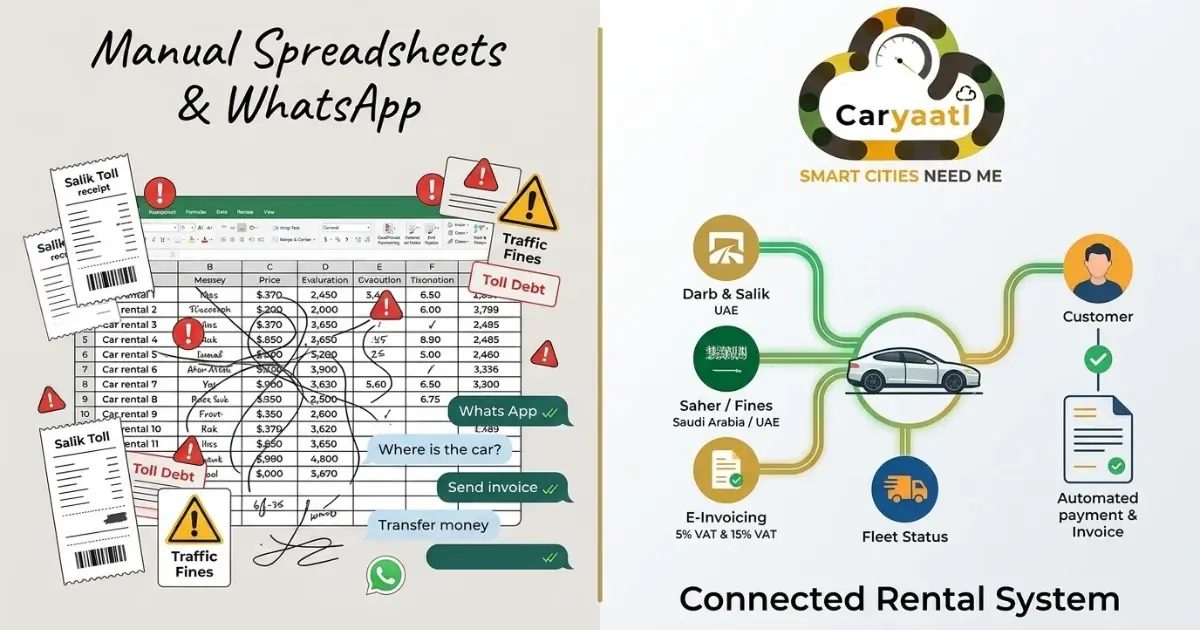
A car rental Excel sheet and a WhatsApp number can run a small fleet. In the UAE and Saudi Arabia, they stop working once Salik tolls, traffic fines, deposits and tax invoices arrive faster than your team can match them to contracts. This guide shows how to set up the sheet properly, where it breaks, what it really costs, and when moving to a connected system like Caryaati pays for itself.
Excel or a rental system? The short answer
Keep Excel while one person runs bookings for a handful of cars and every toll and fine is matched within the week. Switch to a rental system when more than one person edits the file, when charges reach you after the renter has gone, or when e-invoicing deadlines apply to your business.
Your situation | What to do |
Under 10 cars, one person handles bookings, no unmatched tolls or fines | Keep the sheet and use the setup below |
10 to 30 cars, two or more people edit bookings, occasional missed charges | Plan the move this quarter |
30+ cars, several branches, or e-invoicing obligations coming | Switch now |
The "7 signs" checklist later in this guide gives you a score, so the decision rests on your own numbers.
Setting up a car rental Excel sheet: six tabs and three formulas
If you are staying on a spreadsheet for now, set it up so it catches the mistakes that cost the most. This version works in Excel 365 and Google Sheets.
The six tabs and what each one tracks
Tab | Columns |
Bookings | Booking ID, plate, customer, pick-up date and time, return date and time, daily rate, deposit, status |
Fleet | Plate, model, Mulkiya expiry, insurance expiry, current km, next service km |
Tolls | Plate, gate, crossing date and time, amount, matched booking |
Fines | Fine number, plate, offence date and time, amount, matched booking, recharged (yes or no) |
Deposits | Booking ID, amount, date taken, date released, deductions |
Invoices | Invoice number, booking ID, net amount, 5% VAT, total, date |
Enter every date with its time (for example 20/11/2026 17:20). Tolls and fines are matched to the minute, so a date without a time is not enough. If you take deposits by card, see how taking and releasing deposits online works.
Can you run a car rental business on Excel and WhatsApp?
Yes, up to a point. Many rent-a-car companies in Dubai and Riyadh started exactly this way, and both tools have real strengths.
What a spreadsheet does well
It is free, everyone on the team already knows it, and you can shape it around the way you work. For a few cars and one person doing the bookings, it is often enough.
What WhatsApp does well
It is where UAE and Saudi customers already are. A quick quote, a photo of the car and a location pin close many bookings faster than any form.
The trouble starts when the business grows and the two tools have to share information. A booking agreed in a chat has to be retyped into the sheet, a toll has to be matched by hand, and every handover adds another chance to miss a charge.
Where the spreadsheet breaks: five UAE and Saudi jobs Excel was never built for
These five jobs exist because of how tolls, fines and tax work in the Gulf. Each one is manageable in a sheet with a few cars and becomes a daily problem with thirty.
Salik's time-based tolls and Darb's peak hours
Since 31 January 2025, Salik charges AED 6 per crossing at weekday peak hours (6 to 10 am and 4 to 8 pm), AED 4 at other times, and nothing between 1 am and 6 am. The same gate can cost three different amounts in one day, so every crossing has to be priced by its exact time and matched to the booking open at that minute. Darb in Abu Dhabi also charges at set peak times, with its own rules.
In a sheet, that means copying crossings line by line. Caryaati automates Salik and Darb and ties each charge to the rental it belongs to. For the full workflow, see how to match Salik tolls to contracts.
Traffic fines that arrive after the car is back
Fines are registered against the vehicle, not the driver. Staff then search old bookings to find who had the car at the minute of the offence, often after the renter has left and the deposit has been returned. Caryaati automates fines alongside tolls, so each one is traced to its location.
5% VAT invoices now, mandatory e-invoicing from 2027
UAE VAT is 5%, administered by the Federal Tax Authority. Under the Ministry of Finance's e-invoicing timeline, businesses with annual revenue of AED 50 million or more must issue e-invoices from 1 January 2027, and other businesses from 1 July 2027, through an accredited service provider. A spreadsheet can produce a tax invoice, but it cannot send a structured e-invoice. Caryaati has VAT accounting built in, so invoices come from the same record as the booking.
Saudi Arabia: 15% VAT, ZATCA e-invoicing and Tajeer contracts
Saudi VAT is 15%. ZATCA has required e-invoices since 4 December 2021, and its second phase, which connects invoicing systems to the Fatoora platform, has been rolled out in waves since 1 January 2023. Rental contracts are issued electronically through Tajeer, the Transport General Authority's platform. Neither job can be done from a spreadsheet. If you operate in Saudi Arabia, ask to see both in your Caryaati demo.
Overlapping bookings, extensions and car swaps
One plate can sit on several bookings in a week, and an extension or a breakdown swap breaks the simple rule of one car, one contract. When two people edit the file at once, one of them overwrites the other. Caryaati keeps one record per rental, from booking to return, so the car's status is the same for everyone.
What WhatsApp cannot do as a booking channel
WhatsApp is a good place to talk to customers. As the place where bookings live, it creates three problems.
Enquiries that wait in someone's phone
An enquiry that arrives at 11 pm, or while the only agent is at the counter, often waits until the next day. Speed matters: a 2011 Harvard Business Review study found that firms contacting a lead within an hour were nearly seven times as likely to qualify it as firms that waited longer, and more than 60 times as likely as those that waited 24 hours or more. Caryaati's AI agents reply on WhatsApp 24/7, in Arabic, English and other languages.
Emirates ID and passport copies in chat
The UAE's Personal Data Protection Law (Federal Decree-Law No. 45 of 2021) and Saudi Arabia's PDPL, in force since September 2023, expect personal data to be collected for a clear purpose, kept secure and deleted when it is no longer needed. ID photos saved in staff phones and chat backups are hard to protect, track or delete on request. Keep them in one secured system with limited access.
No single record from enquiry to invoice
The quote lives in a chat, the booking in a sheet and the invoice somewhere else. When a customer disputes a charge, staff search three places to rebuild what was agreed.
Spreadsheet vs a connected rental system: side by side
Job | Excel and WhatsApp | Caryaati |
Car availability | Updated by hand; two editors can overwrite each other | One record per rental, the same status for everyone |
Salik and Darb | Crossings copied and matched line by line | Automated and tied to each rental |
Traffic fines | Searched for in old bookings | Automated and traced to the rental |
VAT invoices | Built by hand from the booking | VAT accounting built in |
E-invoicing, ZATCA and Tajeer | Not possible from a sheet | Ask to see your country's setup in a demo |
Enquiries after hours | Wait until someone is free | AI agents reply 24/7 |
Deliveries and pickups | Sent to drivers in chats | Built-in driver app |
Profit per car | Worked out separately, if at all | Cash flow, depreciation and per-car profit reports |
Team access | One shared file for everyone | User roles for each staff member |
See how Caryaati car rental software brings these jobs into one system, with 21 modules on one login.
What running rentals on spreadsheets really costs: a 30-car Dubai example
The costs of a spreadsheet are real but hidden, because nobody invoices you for a toll you forgot to recharge. This example puts numbers on them. The figures are illustrative assumptions, so replace them with your own.
The assumptions
Input | Example value |
Fleet size | 30 cars |
Cars on rent each day | 21 (70% utilisation) |
Salik crossings per rented car per day | 2, at an average of AED 5 |
Traffic fines per month | 10, at an average of AED 600 |
Staff time on matching, retyping and chasing | 15 hours a week, at AED 50 an hour |
Average booking value | AED 1,500 |
Where the money goes each month
Leak | How it is worked out | Monthly cost |
Tolls never recharged | 21 cars × 2 crossings × AED 5 × 30 days = AED 6,300; 5% missed | AED 315 |
Fines never recovered | 10 fines × AED 600 = AED 6,000; 10% missed | AED 600 |
Enquiries lost to slow replies | 2 bookings × AED 1,500 | AED 3,000 |
Staff hours | 15 hours × 52 weeks ÷ 12 months = 65 hours × AED 50 | AED 3,250 |
Total | AED 7,165 |
The error side is not imaginary either: research by Raymond Panko at the University of Hawai'i found errors in most spreadsheets audited in real businesses.
Set against the cost of a system
Caryaati starts from AED 167 a month, billed yearly, with every app and module included. In this example, the monthly leak is more than three times the yearly price. Even if your real numbers are a quarter of these, the leak is still about ten times the monthly price.
7 signs your rental business has outgrown Excel
Give yourself one point for each sign that is true today.
In the last month, you found a toll or fine you could not match to a booking.
You have had a double booking or a missed handover in the last 90 days.
More than one person edits the booking file every day.
You cannot say last month's profit per car within an hour.
Enquiries regularly wait more than an hour for a reply.
Customer ID copies sit in staff phones.
E-invoicing in the UAE, or ZATCA and Tajeer in Saudi Arabia, applies to your business.
Score | What it means |
0 to 1 | Keep the sheet, set up as above |
2 to 3 | Plan the move this quarter |
4 or more | Switch now; the spreadsheet is already costing more than a system |
Switching from Excel: what to clean before you move
A clean sheet makes the move quick. Do these four things first.
Tidy the fleet and customer lists. One row per car and per customer, no duplicates, with plates written the same way every time.
Close or clearly mark open bookings. Note which rentals are still out and when each car is due back.
Settle tolls and fines up to the switch date. Match and recharge everything before the cut-over, so nothing falls between the two systems.
Run both side by side for one week. Check that bookings, tolls and invoices agree before you retire the sheet.
Caryaati can import your existing data from Excel, so your fleet and customers do not have to be typed in again.
Frequently asked questions
Can I use Excel to manage a car rental business?
Yes, for a small fleet where one person handles bookings and every toll and fine is matched within the week. Once several people edit the file, or charges arrive after renters have left, errors and missed recharges grow faster than the fleet. That is the point of moving to a rental system.
How do I keep track of rental cars in a spreadsheet?
Use separate tabs for bookings, fleet, tolls, fines, deposits and invoices. Record every pick-up, return, crossing and offence with its date and time, check for overlapping bookings with a formula, and match each toll and fine to the booking open at that minute.
When should a car rental company switch from Excel?
When two or more of the seven signs in this guide are true: unmatched tolls or fines, double bookings, several people editing the file, no clear profit per car, slow replies to enquiries, ID copies in staff phones, or e-invoicing obligations. With four or more, switch now.
What are the disadvantages of Excel for a rental business?
A spreadsheet cannot pull Salik crossings or fines on its own, stop two people overwriting each other, keep an audit trail of changes, or issue e-invoices. It also spreads customer data across files and phones, which makes data protection harder.
Can rental companies keep customer ID copies on WhatsApp?
Data protection laws in the UAE and Saudi Arabia expect personal data to be kept for a clear purpose, stored securely and deleted when no longer needed. ID photos in staff phones and chat backups are hard to secure or delete on request, so keep them in one secured system with limited access.
Does Caryaati work for rental companies in Saudi Arabia?
Yes. Caryaati is built for rent-a-car companies in the UAE and Saudi Arabia. In a demo, ask how your Saudi requirements, such as 15% VAT, ZATCA e-invoicing and Tajeer contracts, are handled for your business.
See your spreadsheet running as one system
Caryaati brings bookings, fleet, Salik, Darb, traffic fines and VAT accounting into one system. Contracts, reservations and leads are automated, cash flow and per-car profit reports are ready when you need them, drivers get their own app for deliveries and pickups, and AI agents answer customers around the clock. Plans start from AED 167 a month, billed yearly, with every module and 24/7 local support included.
Book a Caryaati demo and see where each tab of your sheet lives in the system.