
For car rental companies in Dubai, every Salik crossing is charged to the company first, because the tag and the account are in its name, not the renter's. The real work is matching each crossing to the renter who had the car at that minute and recharging it before the deposit goes back. This guide shows how to do that, where the money slips away, and how Caryaati handles it automatically.
How Salik works when the car belongs to a rental company
The tag, the account and who pays first
Salik is Dubai's electronic road toll system. It is run by Salik Company, which is listed on the Dubai Financial Market, under an agreement with the Roads and Transport Authority (RTA). Each car carries a Salik tag on its windscreen, and every pass under a toll gate is charged to the account linked to that tag.
On a rental car, that account belongs to the rental company. The renter drives, the company pays, and the money only comes back if the company recharges the renter correctly.
Why the time of every crossing matters
Since 31 January 2025, Salik has used variable pricing. A crossing costs AED 6 during weekday peak hours (6 to 10 am and 4 to 8 pm), AED 4 at other times, and nothing between 1 am and 6 am. Sundays, public holidays and Ramadan follow their own timings, published on salik.ae.
So the gate alone does not tell you the price. Two crossings at the same gate on the same day can cost AED 6 and AED 0, which means every charge has to be read with its exact time.
What a Salik trip record tells you
Each crossing appears as a trip record with the plate number, the gate, the date and time, and the amount. That is everything a rental company needs to recharge the renter, provided it can line the record up with the right rental agreement.
Where rental companies lose Salik money
Most losses are not wrong charges. They are charges nobody ever linked to a renter.
Trips checked only after the car is back
Crossings are recorded against the plate, not the person. If nobody reviews the account until month-end, the renter has already returned the car, the security deposit may be released, and recovering a few dirhams turns into a phone chase.
Extensions, swaps and replacement cars
A renter who extends by two days, or moves to another car after a breakdown, breaks the simple rule of one plate, one contract. Crossings after the original end date, or on the second car, often end up on nobody's invoice.
Trips no renter made
Staff deliver cars to hotels, collect them from the airport and take them to the workshop. Those crossings belong to the company. Charge them to a renter by mistake and you invite a dispute; ignore them and they hide inside your toll total.
Low tag balance
If a fleet account runs low, a crossing can turn into a Salik violation, and a violation fine costs far more than the toll. Topping up the account should be as routine as checking fuel.
Salik toll reconciliation: matching every trip to a rental agreement
Whether you work in a spreadsheet or in software, reconciliation follows the same five steps. Run them every week rather than at month-end, while renters are still easy to reach.
Export the trips for the period, by plate number. Include the time of each crossing to the minute.
Match each crossing to the contract open at that minute. Compare it with the actual check-out and check-in times for that plate, not the booked ones.
Separate staff trips and crossings with no contract. Anything outside a contract window is either a staff trip or a gap in your records. Label it; don't charge it.
Add the toll and your admin fee to the renter's invoice. Show each crossing as its own line (gate, date, time, amount), with the fee on a separate line.
Send the renter the trip list before you charge. A list with gates and times answers most questions before they become complaints.
Matching by hand vs in the Caryaati dashboard
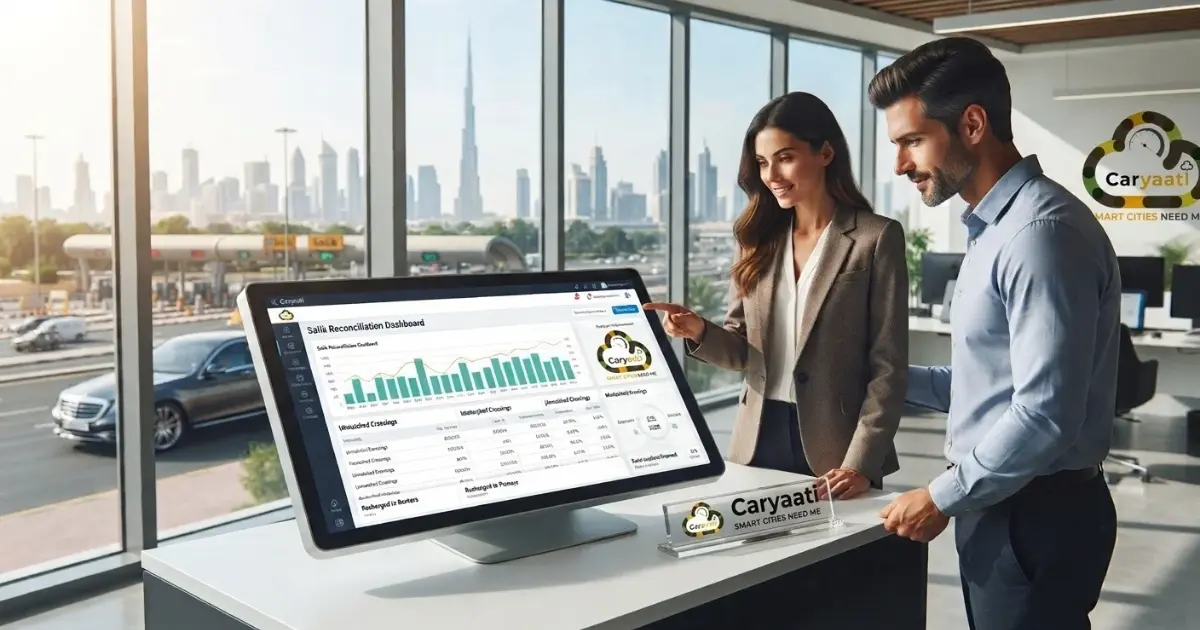
Done by hand, those five steps take hours every week and still miss trips. Caryaati car rental software automates Salik and Darb and ties each charge to the rental it belongs to.
Task | By hand | In Caryaati |
Finding the right contract | Staff compare crossing times with contract times, plate by plate | Each charge is tied to the rental it belongs to |
Billing the renter | The toll is retyped onto the invoice | The toll goes onto the renter's invoice from the same record as the booking |
VAT and reporting | A separate spreadsheet for accounts | VAT accounting is built in, and tolls count in profit per car |
Darb and traffic fines | Two more processes, run the same way | Automated in the same system as Salik |
Worked example: A five-day rental with eight crossings
A car is delivered to a renter's hotel on Monday at 9:00 am and collected on Saturday at 9:00 am. These are its Salik crossings. (Example only; rates follow Salik's variable pricing as published in 2025.)
# | Gate | Crossing time | Toll | Charged to |
1 | Al Garhoud Bridge | Mon 8:40 am | AED 6 (peak) | Company: staff delivery |
2 | Al Maktoum Bridge | Mon 5:20 pm | AED 6 (peak) | Renter |
3 | Airport Tunnel | Tue 2:15 am | AED 0 (free hours) | Renter, nothing to bill |
4 | Al Barsha | Tue 1:05 pm | AED 4 | Renter |
5 | Business Bay Crossing | Wed 7:50 am | AED 6 (peak) | Renter |
6 | Jebel Ali | Thu 9:30 pm | AED 4 | Renter |
7 | Al Safa South | Fri 4:45 pm | AED 6 (peak) | Renter |
8 | Al Mamzar South | Sat 10:20 am | AED 4 | Company: staff return to branch |
The renter owes AED 26 in tolls, plus your admin fee. The company carries AED 10 as its own cost. Billing by plate alone would have charged the renter AED 36, including two trips they never made.
What your team still decides
Matching is mechanical; judgement is not. Your team still decides whether to waive a toll for a corporate client, how to settle a dispute, and whether a late collection was the renter's fault. With the trip, the contract and the invoice in one place, those calls take minutes instead of a search through three systems.
How to recharge Salik to renters without arguments
Put it in the rental agreement before the keys change hands
State that Salik and Darb tolls are charged to the renter, how they will be billed, and what admin fee applies. A renter who signed that line rarely argues the charge later.
Setting a fair Salik admin fee
The fee should cover real work: checking the account, matching trips and billing them. Show it on a separate line from the tolls, either per crossing or per rental, and keep it the same for every renter. A fee that looks bigger than the tolls themselves is what turns a routine charge into a complaint.
VAT on recharged tolls and fees
Your admin fee is part of your service, so 5% VAT normally applies to it. Whether VAT applies to the toll itself depends on how you pass it on, so agree the treatment with your tax adviser and apply it the same way on every invoice.
Answering a renter who disputes a toll
Send facts, not an argument: the gate, the date and time of each crossing, the plate, and the check-out and check-in times on the contract. When the times line up, the charge explains itself.
Darb in Abu Dhabi: the same job, different rules
Darb is Abu Dhabi's toll system. It charges at set peak times rather than at every hour, and its account rules differ from Salik's, so a car driven between Dubai and Abu Dhabi can pick up both kinds of charge on one rental. The matching logic stays the same: plate, time, contract. Caryaati handles Darb in the same flow as Salik.
Four numbers to check every month
Share of tolls recharged: tolls billed to renters, divided by all tolls paid minus staff trips. This should sit close to 100%.
Unmatched crossings: trips with no contract and no staff label. Each one is either lost money or a record gap.
Days from crossing to invoice: the shorter it is, the fewer renters you chase after the deposit is back.
Disputed tolls: how many renters questioned a charge, and why. A rising number usually points to the agreement wording or the fee.
If the first number falls well short of 100%, money is leaking somewhere in the five reconciliation steps above.
Frequently asked questions
Who pays Salik on a rental car, the company or the renter?
The rental company pays first, because the Salik tag and account are in its name. It then recharges the renter for crossings made during the rental, usually with an admin fee stated in the rental agreement. Crossings made by staff, before handover or after return, stay with the company.
Can a rental company add an admin fee to Salik charges?
Yes. Rental companies commonly add one to cover the work of checking, matching and billing tolls. State it in the rental agreement before the rental starts, show it separately from the tolls on the invoice, and apply VAT to it as part of your service.
Why do two crossings at the same gate cost different amounts?
Because Salik prices change with the time of day. A weekday peak crossing costs AED 6, other times AED 4, and crossings between 1 am and 6 am are free. Always bill renters from the actual crossing time, never a flat rate per gate.
What happens if a rental car crosses a gate with a low tag balance?
The crossing is still recorded, and if the account is not topped up in time it becomes a Salik violation with a fine. Keep fleet accounts topped up: a violation costs far more than the toll and can be hard to recover from the renter.
Does Salik apply to cars rented in Abu Dhabi or Sharjah?
Yes. Salik charges any car that passes a Dubai toll gate, whichever emirate it was rented in. A car rented in Sharjah and driven into Dubai pays Salik, and a car driven on to Abu Dhabi can pick up Darb charges as well.
How does Caryaati charge Salik to renter?
Caryaati automates Salik and Darb and ties each charge to the rental it belongs to, so the toll lands on the renter's invoice instead of your expenses. Tolls, traffic fines and VAT accounting sit in the same system as your bookings and fleet.
See Salik matching in a Caryaati demo
Every unmatched crossing is money your company has already paid. Book a Caryaati demo and see how each toll is matched to its rental, from the crossing to the renter's invoice.